

Life Sciences in Motion
The future of medicine emerges where research, technology, and industrial implementation converge. At this intersection, Styria is positioning itself as a dynamic life science hub in Europe.
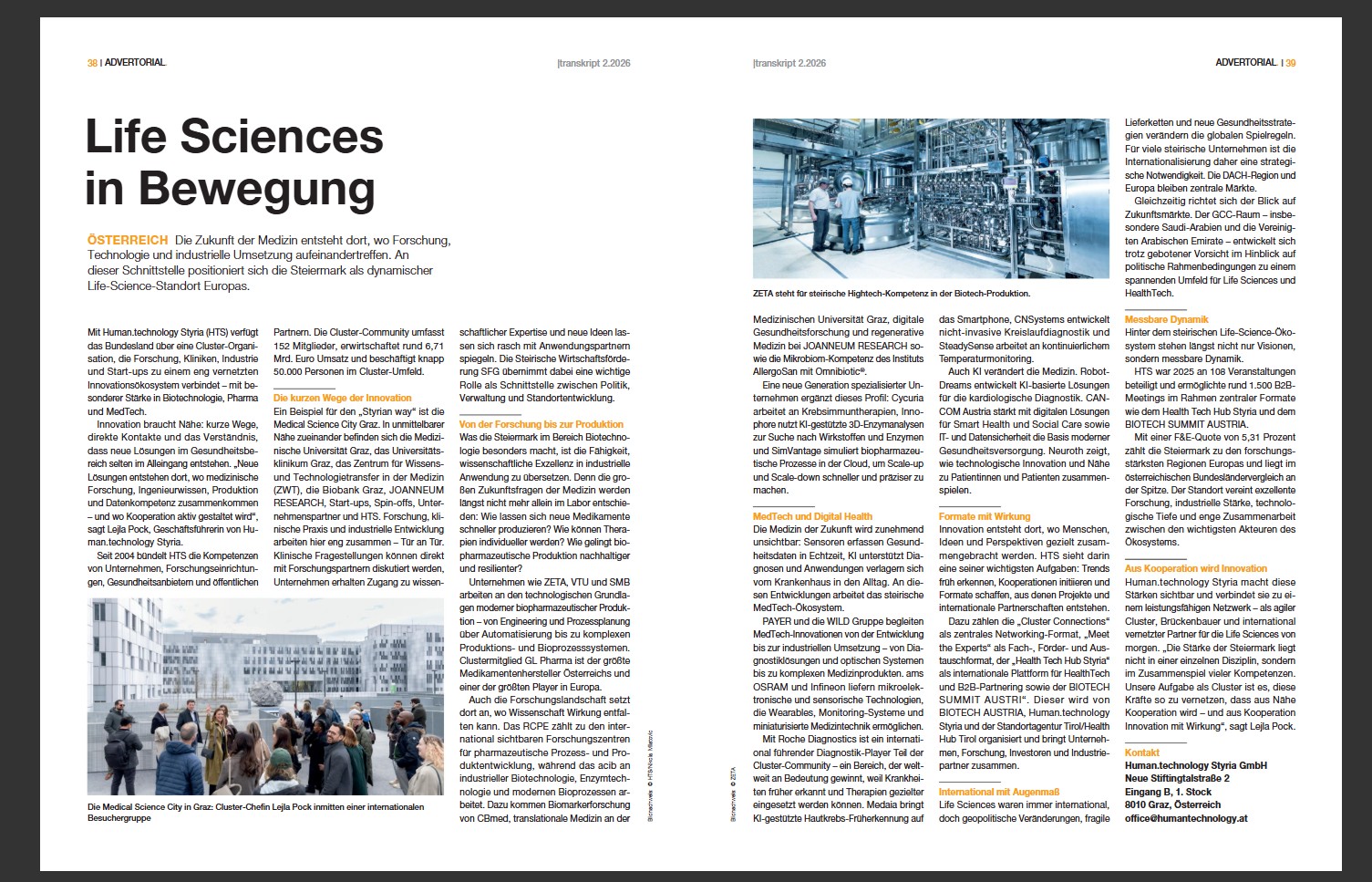
With Human.technology Styria (HTS), the federal state has a cluster organization that connects research, clinics, industry and start-ups into a closely networked innovation ecosystem – with particular strength in biotechnology, pharmaceuticals and MedTech.
Innovation requires proximity: short communication channels, direct contacts, and the understanding that new solutions in the healthcare sector rarely emerge in isolation. "New solutions arise where medical research, engineering expertise, production, and data competence converge – and where cooperation is actively fostered," says Lejla Pock, Managing Director of Human.technology Styria.
Since 2004, HTS has been pooling the expertise of companies, research institutions, healthcare providers, and public partners. The cluster community comprises 152 members, generates approximately €6,71 billion in revenue, and employs nearly 50.000 people in the cluster environment.
The short paths of innovation
An example of the "Styrian way" is the Medical Science City Graz. The Medical University of Graz, the Graz University Hospital, the Center for Knowledge and Technology Transfer in Medicine (ZWT), the Graz Biobank, JOANNEUM RESEARCH, start-ups, spin-offs, corporate partners, and HTS are all located in close proximity to one another. Research, clinical practice, and industrial development work closely together here – side by side.
Clinical questions can be discussed directly with research partners, companies gain access to scientific expertise, and new ideas can be quickly reviewed with application partners. The Styrian Business Promotion Agency (SFG) plays a key role in this process, acting as an interface between politics, administration, and regional development.
Biotech: from research to production
What makes Styria special in the field of biotechnology is its ability to translate scientific excellence into industrial application. The major future questions in medicine are no longer decided solely in the laboratory: How can new drugs be produced faster? How can therapies become more personalized? How can biopharmaceutical production be made more sustainable and resilient?
Companies like ZETA, VTU, and SMB are working on the technological foundations of modern biopharmaceutical production – from engineering and process planning to automation and complex production and bioprocess systems. Cluster member GL Pharma is Austria's largest pharmaceutical manufacturer and one of the biggest players in Europe.
The research landscape also focuses on areas where science can have an impact. The RCPE is among the internationally renowned research centers for pharmaceutical process and product development, while the acib works on industrial biotechnology, enzyme technology, and modern bioprocesses. In addition, there is biomarker research from CBmed, translational medicine at the Medical University of Graz, digital health research and regenerative medicine at JOANNEUM RESEARCH, and the microbiome expertise of the AllergoSan Institute with Omnibiotic®.
A new generation of specialized companies complements this profile: Cycuria works on cancer immunotherapies, Innophore uses AI-supported 3D enzyme analyses to search for active ingredients and enzymes, and SimVantage simulates biopharmaceutical processes in the cloud to make scale-up and scale-down faster and more precise.
MedTech and Digital Health
The medicine of the future is becoming increasingly invisible: sensors capture health data in real time, AI supports diagnoses, and applications are shifting from hospitals into everyday life. The Styrian MedTech ecosystem is working on these developments.
PAYER and the WILD Group support MedTech innovations from development to industrial implementation – from diagnostic solutions and optical systems to complex medical devices. ams OSRAM and Infineon supply microelectronic and sensor technologies that enable wearables, monitoring systems, and miniaturized medical technology.
Roche Diagnostics, a leading international diagnostics player, is part of the cluster community – a field that is gaining importance worldwide because diseases can be detected earlier and therapies can be used more precisely. Medaia is bringing AI-supported skin cancer early detection to smartphones, CNSystems is developing non-invasive circulatory diagnostics, and SteadySense is working on continuous temperature monitoring.
AI is also transforming medicine. RobotDreams develops AI-based solutions for cardiological diagnostics. CANCOM Austria strengthens the foundation of modern healthcare with digital solutions for smart health and social care, as well as IT and data security. Neuroth demonstrates how technological innovation and patient-centered care can work together.
Formats with impact
Innovation arises where people, ideas, and perspectives are purposefully brought together. HTS sees this as one of its most important tasks: recognizing trends early, initiating collaborations, and creating formats from which projects and international partnerships emerge.
These include “Cluster Connections” as a central networking format, “Meet the Experts” as a specialist, funding and exchange format, the “Health Tech Hub Styria” as an international platform for HealthTech and B2B partnering, and the “BIOTECH SUMMIT AUSTRIA”. This latter event is organized by BIOTECH AUSTRIA, Human.technology Styria and Standortagentur Tirol / Health Hub Tirol and brings together companies, researchers, investors and industry partners.
International with a sense of proportion
Life sciences have always been international – but geopolitical shifts, fragile supply chains, and new healthcare strategies are changing the global rules of the game. For many Styrian companies, internationalization is therefore a strategic necessity. The DACH region and Europe remain key markets.
At the same time, attention is turning to future markets. The GCC region – particularly Saudi Arabia and the United Arab Emirates – is developing into an exciting environment for life sciences and health tech, despite the need for caution regarding the political framework.
Measurable impact
Behind the Styrian life science ecosystem lie not just visions, but measurable dynamism. In 2025, HTS participated in 108 events and facilitated around 1.500 B2B meetings within key formats such as the Health Tech Hub Styria and the BIOTECH SUMMIT AUSTRIA.
With an R&D expenditure of 5,31 percent, Styria is one of the strongest research regions in Europe and leads the Austrian federal states. The region combines excellent research, industrial strength, technological depth, and close collaboration between the key players in the ecosystem.
Human.technology Styria makes these strengths visible and combines them into a high-performing network – as an agile cluster, bridge builder, and internationally networked partner for the life sciences of tomorrow. “Styria’s strength lies not in a single discipline, but in the interplay of many competencies. Our task as a cluster is to network these forces in such a way that proximity becomes cooperation – and cooperation becomes impactful innovation,” says Lejla Pock.